

Shopify B2B is a massive step forward for storeowners, making it possible for them to manage their retail and wholesale customers in the same store, but making the management as simple as possible requires the use of an additional app.
B2B power for all
Can you imagine trying to run a business without being connected to the power grid? You might be able to power a single lightbulb with a hand crank, but you’d never scale. Without a reliable power source, your growth would be limited by your own ability to generate electricity manually. Spinning a dynamo by hand to keep all the lights on in your business isn’t really a possibility.
In the world of business-to-business (B2B) e-commerce, Shopify has spent the last few years laying down B2B’s equivalent of the ultimate high-voltage power grid: a heavy backend infrastructure built to support complex wholesale operations with unparalleled stability. But a grid alone isn't enough; to run a business, you need a system to use that power safely and efficiently.
When Shopify B2B capabilities were rolled out to every paid tier, it fundamentally changed the landscape for hybrid merchants, dissolving the barriers to entry for wholesale commerce. Overnight, features that once required enterprise-level budgets, like custom price lists and corporate profiles, became foundational utilities available to everyone.
However, as direct-to-consumer brands flip the switch on this new engine, they often find that while the grid is robust, it lacks the wiring needed to manage it daily, such as frontend gateways and self-service tools. To build a truly scalable wholesale channel, you need to understand where Shopify's infrastructure ends and where ecosystem solutions take over.
The core of Shopify B2B
For years, running a serious B2B operation on Shopify meant either relying heavily on a tangled web of third-party apps and custom development, or maintaining a completely separate "wholesale" expansion store. It worked, but it was clunky, expensive, and a headache to sync.
The situation completely changed, though, when Shopify brought B2B capabilities directly into the core admin. Shopify started testing these features back in 2022 in Plus sites, but finally brought these capabilities to all plans a couple months ago, in April. Today, a merchant can run a thriving direct-to-consumer storefront and a complex wholesale operation side-by-side out of a single backend. It’s like selling to individuals in your main-street storefront, while loading up semis in the back to take your products to sell in department stores across the country.

For the majority of the wholesale work, Shopify B2B’s native features hit the mark spot on. The platform relies on three core pillars to manage the unique relationships inherent to B2B commerce: company profiles, custom catalogs, and flexible payment terms
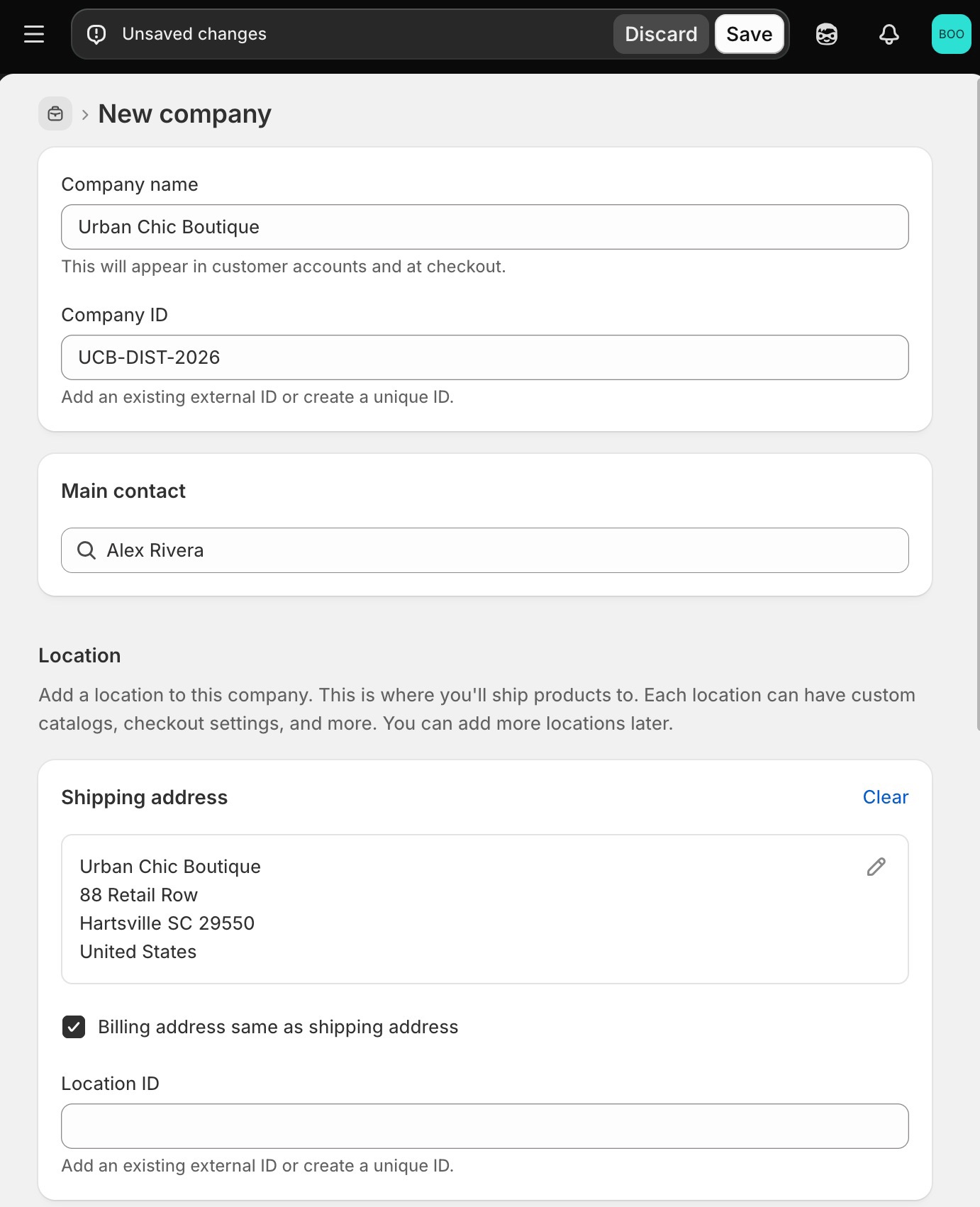
Company Profiles
Instead of treating every customer as an individual, Shopify allows you to group multiple buyers under a single corporate entity. You can assign specific purchasing agents, track a company’s entire order history across different buyers, and manage multiple shipping locations all from one profile.
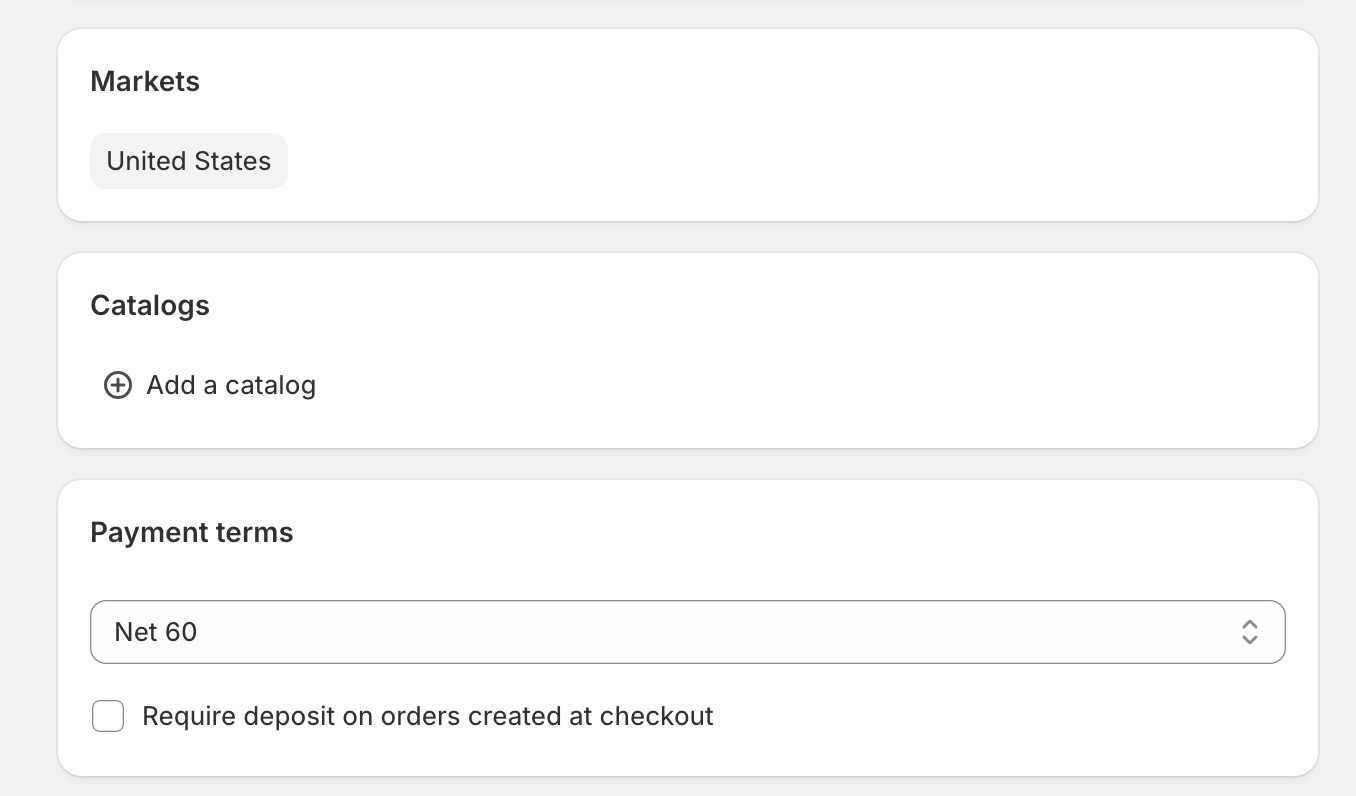
Custom Catalogs and Price Lists
B2B pricing is rarely one-size-fits-all. Native Shopify allows you to create custom price lists that offer percentage-based discounts or fixed wholesale pricing for specific items. You can then tie these price lists to specific Company Profiles, ensuring that when Buyer A logs in, they only see the curated catalog and contracted pricing meant for them.
Flexible payment terms
Cash flow is the lifeblood of B2B. Shopify handles this by letting merchants assign net payment terms (like Net 30, Net 60, or Due on Receipt) directly to a company profile. Buyers can check out without pulling out a credit card, generating an invoice that can be paid later via bank transfer, credit card, or manual payment tracking.
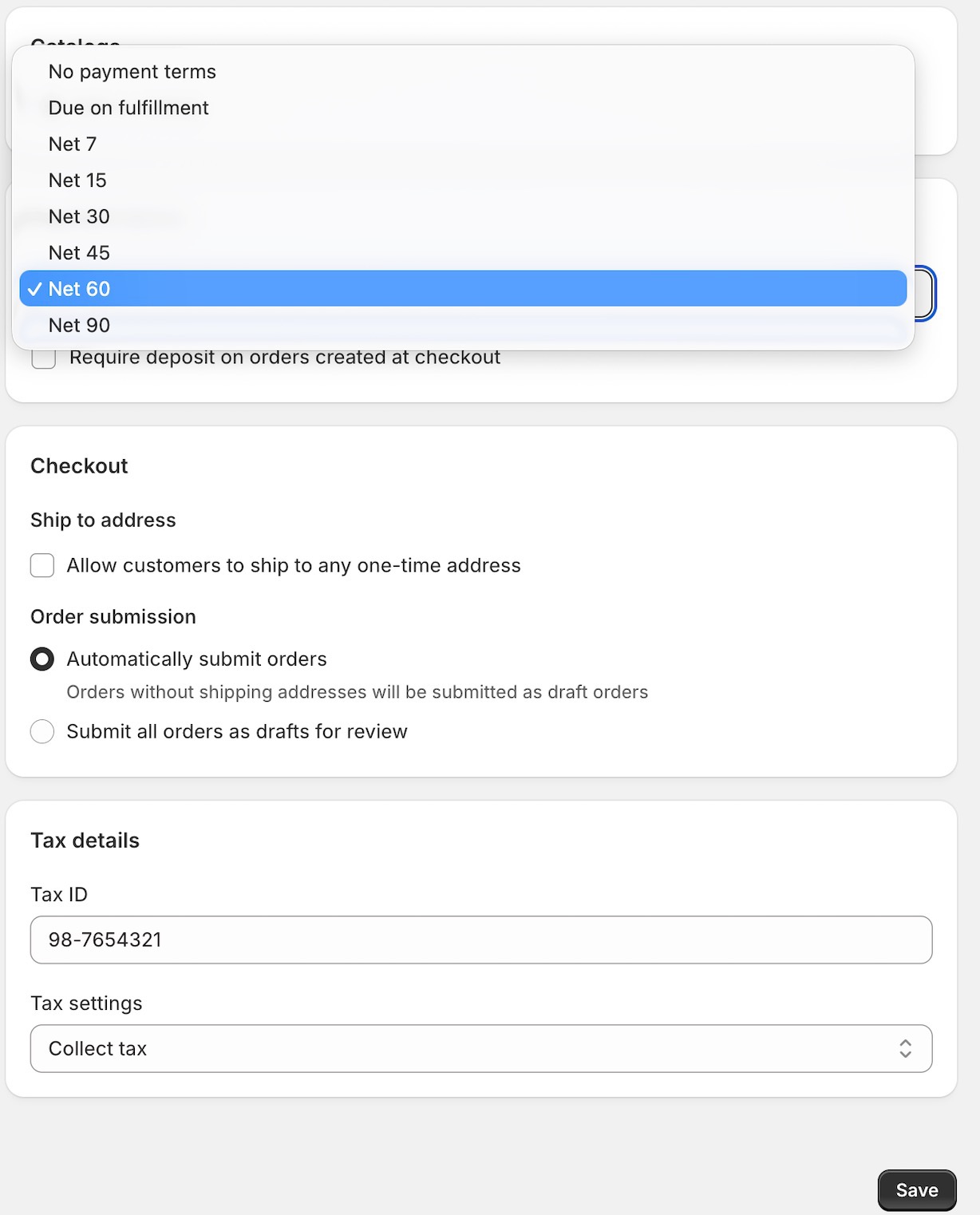
By integrating these features directly into standard Shopify mechanics, merchants get to use the same inventory pools, checkout flows, and analytics they already rely on for retail. It lowers the barrier to entry for wholesale immensely, turning Shopify into a formidable hybrid commerce platform.
The gateway problem: A power grid with no outlets
Because Shopify rolled out these foundational Shopify B2B features to every paid tier, millions of merchants can now theoretically launch a wholesale channel in an afternoon. The backend infrastructure is sitting right there, waiting to be utilized. But as soon as a merchant flips the switch to activate a dedicated B2B storefront, they hit a confusing, frustrating roadblock: the front door is completely locked.
This is what we call the "Gateway Problem."
In a standard direct-to-consumer setup, the acquisition funnel is wide open. Customers land on your site, browse your catalog, add items to their carts, and create accounts at checkout. It’s seamless, public, and automated.
B2B commerce requires a fundamentally different approach. You don't let just anyone buy your products at a 40% volume discount; you need to vet them first. You need to verify their tax ID, confirm their business legitimacy, and check their creditworthiness. Because it requires some due diligence on the your part, Shopify makes you do all the work of managing the B2B business.
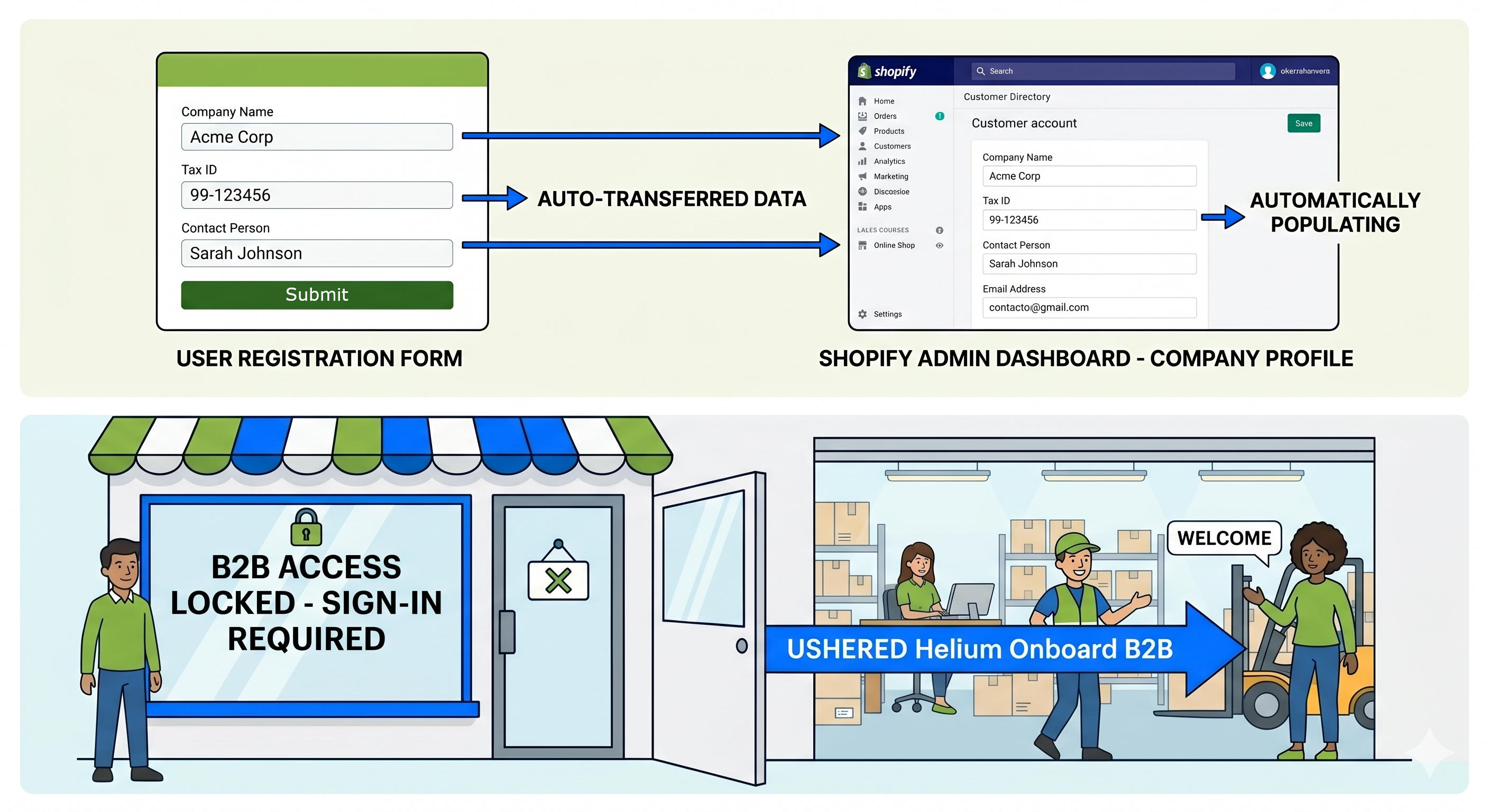
Out of the box, Shopify’s native solution for securing a B2B storefront is a blunt instrument. The first problem is that when you activate the native Shopify B2B access lock, it completely shields the storefront behind a login page.
If an established, pre-approved wholesale buyer arrives at the URL, they can log in via a one-time passcode sent to their email and start shopping. But what happens if a fresh, highly valuable potential retail partner lands on that same page?
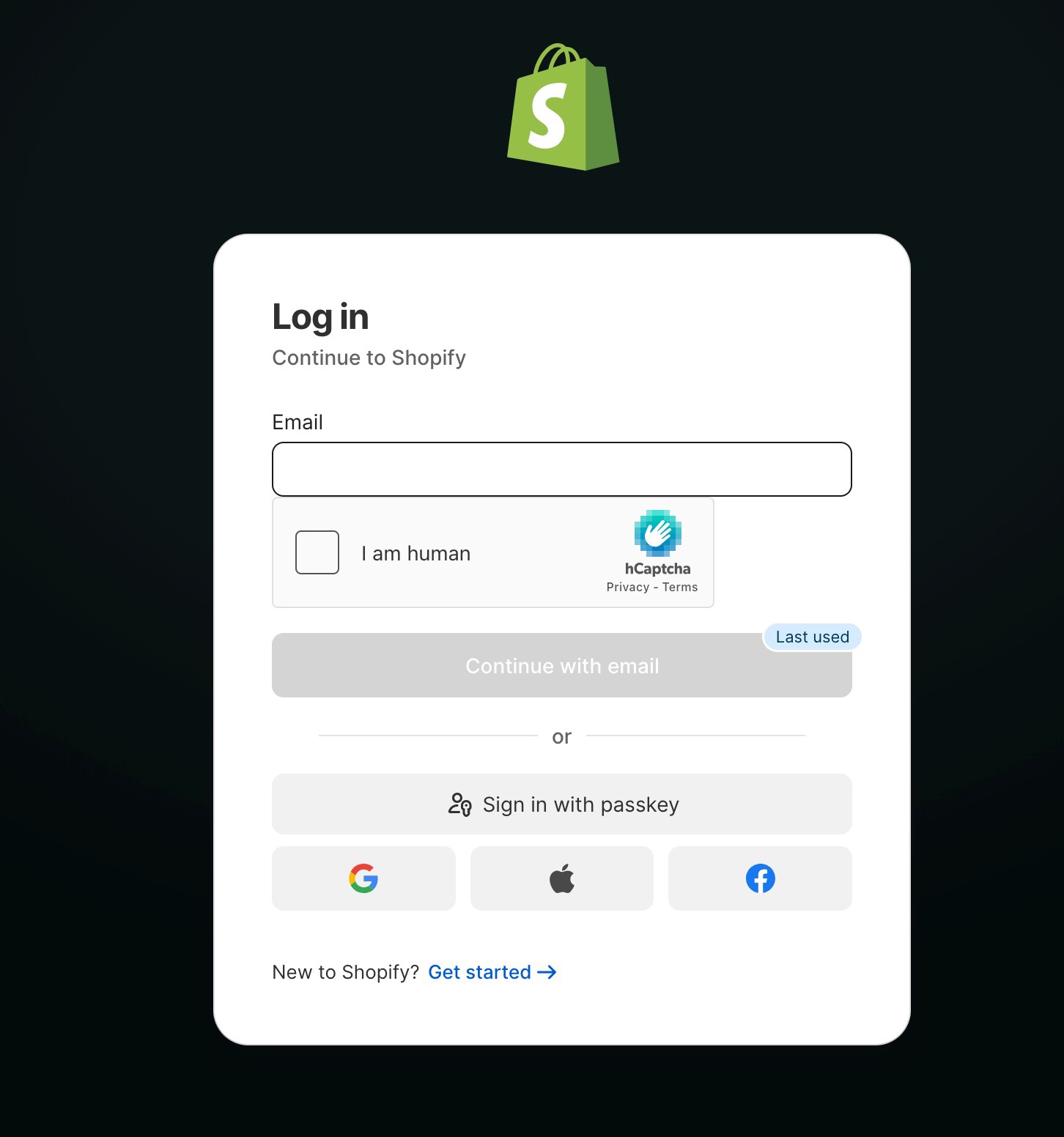
Nothing. They hit a digital brick wall. They can't see anything or even, really, start the process of signing up to be a wholesaler. They have to contact you personally and wait for you to have time to figure out what information you need from them to get started. This begins the process that results in a sometimes lengthy back-and-forth with you just to get started.
While Shopify offers a basic "Shopify Forms" tool, it is not optimized for B2B operations. If you activate Shopify B2B's native storefront access lock, the entire site is shielded behind a login page, which effectively blocks access to public forms. Furthermore, even if you could bypass the lock, these basic tools lack the robust logic required for serious wholesale.
Shopify forms lack the ability to upload tax resale certificates, validate complex business data, or automatically route prospects to specific price catalogs based on their business type. For a platform that prides itself on eliminating friction, this missing link turns an otherwise brilliant native feature into a major operational bottleneck.
Bridging the gap with Onboard B2B
To solve the lack of a native prospect pipeline without compromising store security, merchants have to look to the Shopify app ecosystem. You’ll need an app to function as the control panel and intake meter that safely hooks new users up to the main grid. One of our favorites is Onboard B2B, by our partner, Helium, though there are other apps out there that work similarly.
Instead of completely blocking unauthenticated traffic with a generic login prompt, Helium’s Onboard B2B utilizes Shopify’s native theme app extensions. This allows merchants to implement a dedicated, secure logic layer right on their storefront.
When a new business lead arrives at the site, the system recognizes they aren't logged in but, rather than shutting them out, it routes them to a secure customer application portal. Here is how that workflow actually functions to eliminate the manual overhead:
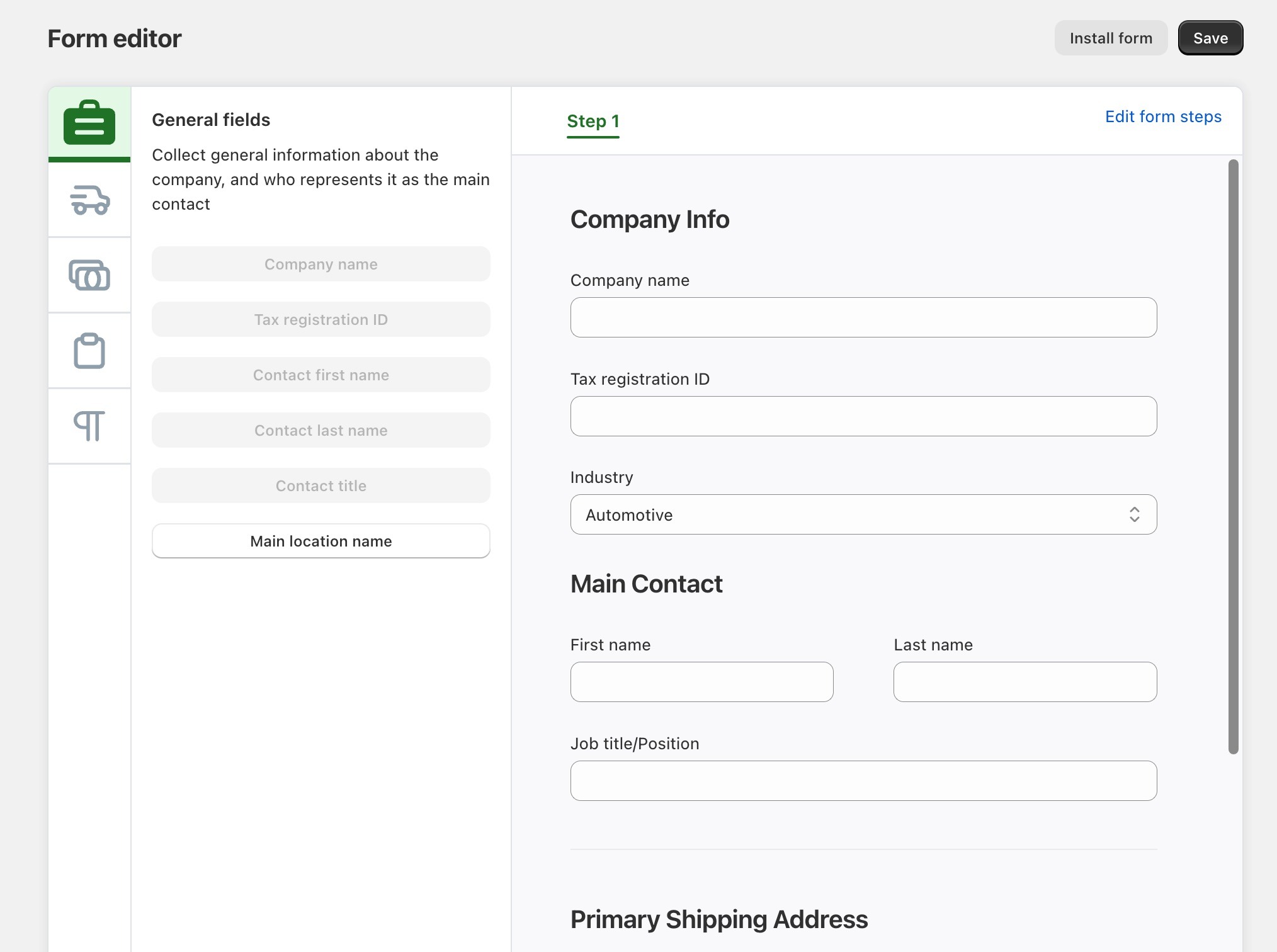
Custom Intake Forms
Merchants can build detailed registration forms tailored to their specific vetting criteria. This means you can mandate fields for tax resale certificates, business licenses, estimated annual volume, or brick-and-mortar address validation right at the first touchpoint.
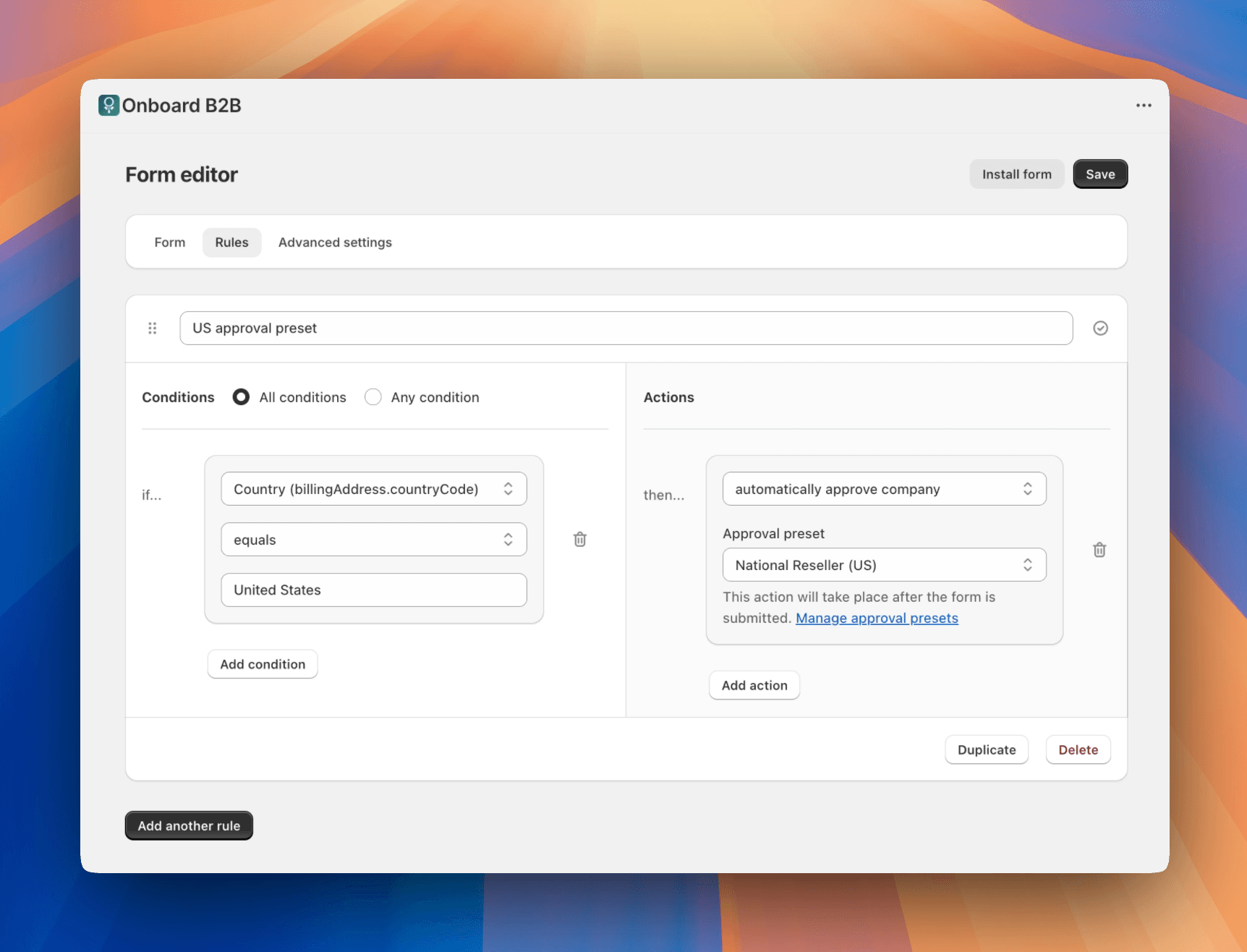
Automated Account Creation
When a prospect submits the form, the data doesn't just sit in an email inbox. Helium routes that data directly into Shopify's backend. If approved (or if they meet the requirements for the autoapproval process), the app automatically generates the corresponding Shopify Company Profile, assigns the correct pricing catalog, and hooks up the designated buyer contact.
Controlled Storefront Visibility
While the prospect is going through the approval pipeline, the rest of the wholesale store remains completely protected. True wholesale pricing and inventory layouts stay hidden until the merchant hits "approve," at which point the system automatically triggers a welcome email inviting the new buyer to log in.
By injecting this automated onboarding layer into the frontend, the software transforms a closed-off catalog into a functional lead-generation tool. It gives merchants the security of a private portal alongside the automated scalability of a standard customer acquisition funnel.
The administrative bottleneck and the overhead of account management
Securing and onboarding a new wholesale client is a major win, but it’s only the beginning of the relationship. Once a Shopify B2B account is active, the daily operational reality sets in. In the business-to-business world, customer accounts are dynamic, living structures. Companies scale, open new offices, open new retail locations, hire new purchasing managers, and see procurement staff move on to other roles.
Natively, Shopify handles the static representation of these corporate hierarchies quite well through Company Profiles. You can tie multiple locations and separate purchasing contacts to a single parent business.
The bottleneck isn’t where the data lives, it’s who has to manage it.
In Shopify’s native environment, the responsibility for updating account information falls squarely on the merchant's customer service or sales operations team. This is a platform-wide limitation that exists on all Shopify plans, including Shopify Plus. Buyers can view order history and reorder, but they have zero administrative power to manage their own corporate entities.
This creates an ongoing, low-value administrative burden for the merchant. Every time a wholesale customer experiences a routine internal change, your team has to get involved manually.
Adding new buying locations
If a regional retail chain client opens a new storefront in a neighboring city, they cannot simply log in and add that shipping destination to their profile. They have to email or call your support team to have it manually created in the Shopify admin.
Managing staff turnover
If a purchasing agent leaves the client's company, or if a new manager is hired with corporate purchasing authority, the client cannot add or revoke those permissions themselves. Your team must manually invite the new contact and associate them with the correct location permissions.
When you multiply this friction across dozens or hundreds of active Shopify B2B clients, a significant chunk of your team's time gets eaten up by basic data entry. It also stalls the client’s ability to buy on their own schedule, turning routine business updates into customer service tickets.
True self-service through scaling Shopify B2B with account extensions
If the onboarding phase is about opening the front door, long-term retention is about making sure the interior is easy to navigate. To truly eliminate the operational bottleneck of daily data entry, a merchant has to shift from a model where they manage the client’s account to a model where the client manages themselves.
This is the exact philosophy behind Helium’s self-management account extensions. By leveraging Shopify’s new customer account UI extensions, Helium embeds administration tools directly into the buyer’s existing portal.
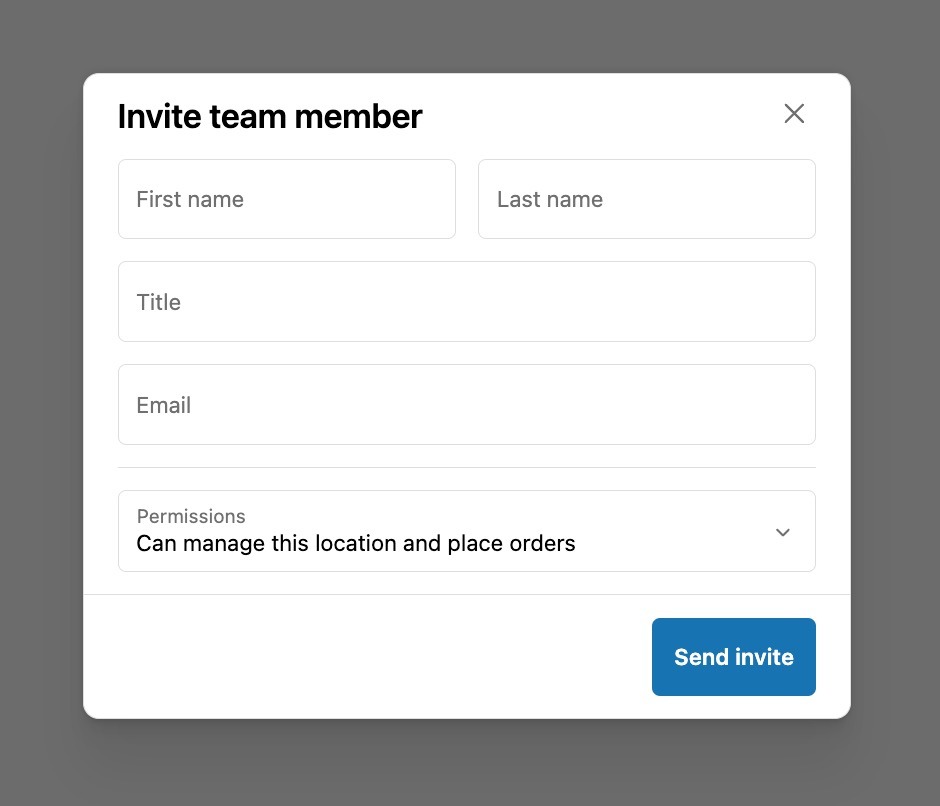
Instead of treating the buyer portal as a passive dashboard where customers can only view invoices and track past shipments, it transforms into an active management console. These tools act as decentralized switches, letting customers manage their own rooms without calling the city utility worker (your support team). This structural shift completely redefines how routine updates are handled:
Decentralized user management
When a client hires a new procurement manager or needs to grant ordering access to a branch supervisor, they no longer have to request it from your support team. The client’s designated corporate admin can log in, click an "Add User" button, type in the new contact’s email, and assign them a specific role—such as a restricted "Ordering Only" buyer or a full "Location Admin"—instantly.
On-the-fly location creation
If a wholesale client expands their operations and opens a new distribution center or retail brick-and-mortar storefront, their internal team can add the new corporate location to their profile entirely on their own. The extension captures the new shipping addresses and matches them against the parent company’s pre-approved tax and catalog parameters.
Zero merchant overhead
Because these modifications happen on the customer-facing frontend but execute securely via Helium’s integration with Shopify’s backend, the merchant's staff never touches a support ticket. The data updates automatically across the system.
This brand of self-service aligns wholesale e-commerce with modern software-as-a-service expectations. Corporate buyers don't want to wait 24 to 48 hours for a customer service rep to add a new employee to their account so they can place a time-sensitive order.
Giving these customers the autonomy to manage their own corporate footprint speeds up their buying cycle, boosts their purchasing frequency, and leaves your internal operations team free to focus on actual business growth.
Balancing native power with ecosystem scale
The evolution of the native Shopify B2B capabilities represents a massive paradigm shift for hybrid commerce. By making enterprise-level wholesale tools accessible to every tier of merchant, Shopify has effectively eliminated the need for fractured, dual-store setups or bloated custom architectures.
The grid was quietly laid down beneath every Shopify store at once, so out of the box the platform gives you all the power you need for your business-to-business sales. But as any growing merchant quickly discovers, to access the power grid your store still needs a control panel.
The native platform provides the structural pillars in the catalogs, the corporate profiles, and the payment terms. However, managing the human element of Shopify B2B, from the initial friction of vetting a new prospect to the daily maintenance of a client's evolving corporate roster, requires a more specialized touch.
Plugging these specific operational gaps with tools like Helium Onboard B2B and their self-service account extensions isn’t bypassing Shopify’s native strengths. Instead, it's optimizing them. By automating the registration gateway and turning administrative tasks over to the buyers themselves, merchants can leverage the full power of Shopify B2B without drowning in manual support tickets.
Ultimately, the most successful B2B storefronts won't just be the ones that turn on native wholesale features, they will be the ones that build a seamless, automated ecosystem around them.