

Shopify's Built-In AI Tools are a great foundation for letting your store take care of AOV and CLV, but for true CRO and to build your enterprise store to new heights, you should avail yourself of app-specific AI expertise too.
Imagine you've just hired the most enthusiastic, tireless, and data-savvy assistant imaginable – one who never calls in sick, never forgets a customer's preferences, and has read every sales report your store has ever produced before their first shift even started. That's essentially what Shopify has built into its platform over the past few years.
While you're focused on the big picture – sourcing great products, building relationships, shaping the brand – there's a diligent little robot behind the counter that can do a remarkable amount of the heavy lifting. Let's look at exactly what it's been up to.
The Art of the Perfect Recommendation
Walk into any great boutique and the best salespeople do something almost magical: they don't just hand you what you asked for, they hand you what you actually want – as well as something you didn't even know you wanted. Shopify's Search & Discovery app is designed to do exactly that, at scale, for every single visitor to your store.
The app goes well beyond a basic search bar. Shopify has built-in strategies to adjust product recommendations based on products that are commonly purchased together, products with a similar description, or products in related collections. This means the engine is constantly reading the behavior of your store – what gets bought together, what categories attract similar shoppers – and surfacing the right products at the right moment on product pages.
And it's not just about static rules. Semantic search uses related words, concepts, categories, and other contexts to improve and expand search results – checking for relationships between concepts and using attributes like product descriptions and image data to do it. In practice, this means a customer who types "gift for coffee lover" can surface exactly what they're looking for even if your product titles don't use those words verbatim.
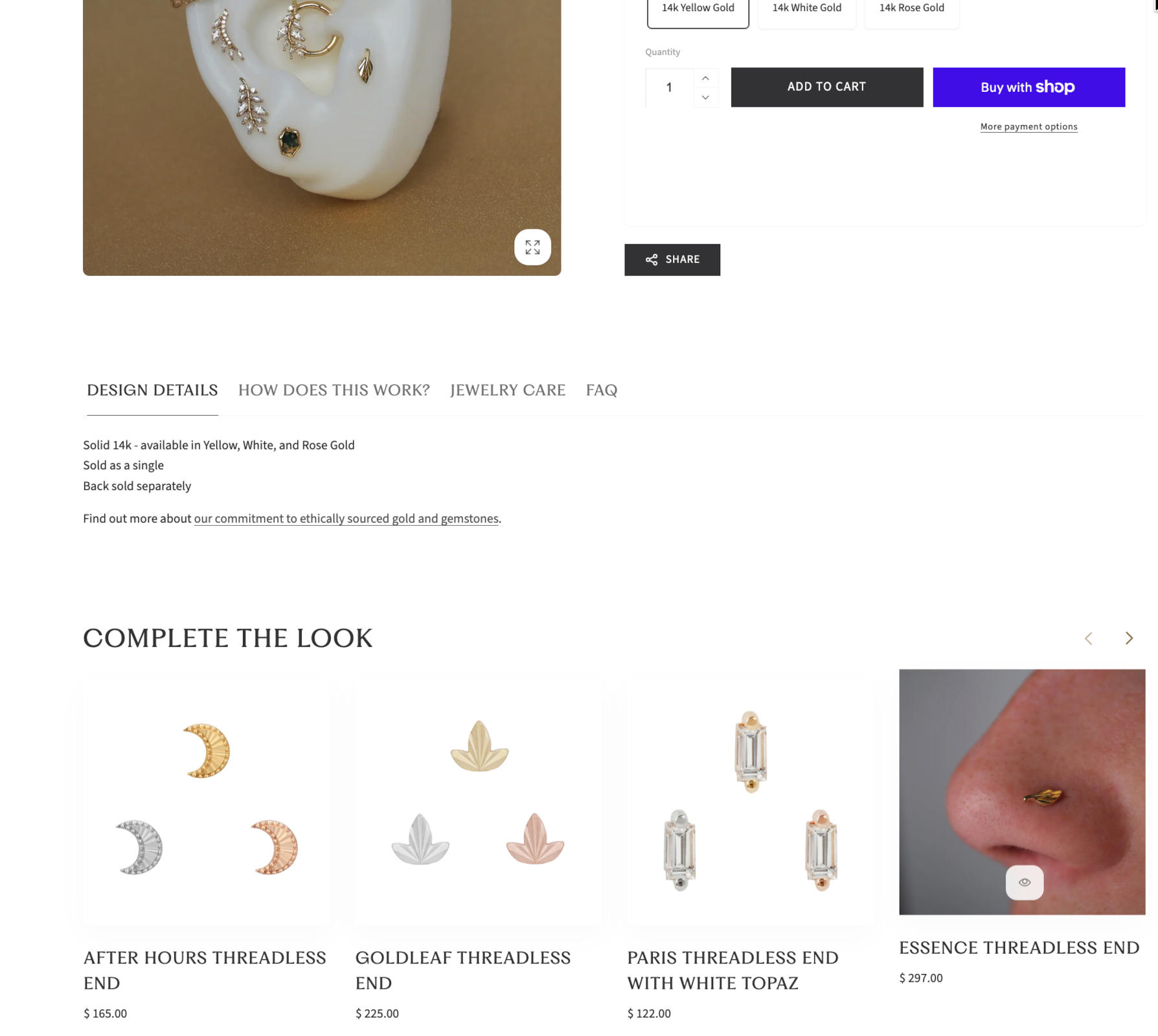
Brands like Buddha Jewelry – the piercing company that focuses on the power of self expression through jewelry – have the Search & Discovery app installed on their store. Someone might start out looking at their Goldleaf Threadless End, but be intrigued by the Essense Threadless End, and add that to their cart as well. This probably was surfaced based on what customers with similar tastes have bought, and it paid off.
It's the digital equivalent of the knowledgeable shop assistant who says, "Oh, if you love that one, you'll want to try this too." The goal is to control product recommendations for more effective cross-selling – and the analytics help improve your store's search and discovery over time, without your having to even dig into the data yourself.
The Chat Window That Does Its Homework
Customer chat widgets have a reputation – often deserved – for being the digital equivalent of being put on hold. A customer types a question and either gets a canned non-answer or waits. Shopify Inbox, powered by Shopify Magic, is trying to change that dynamic entirely.
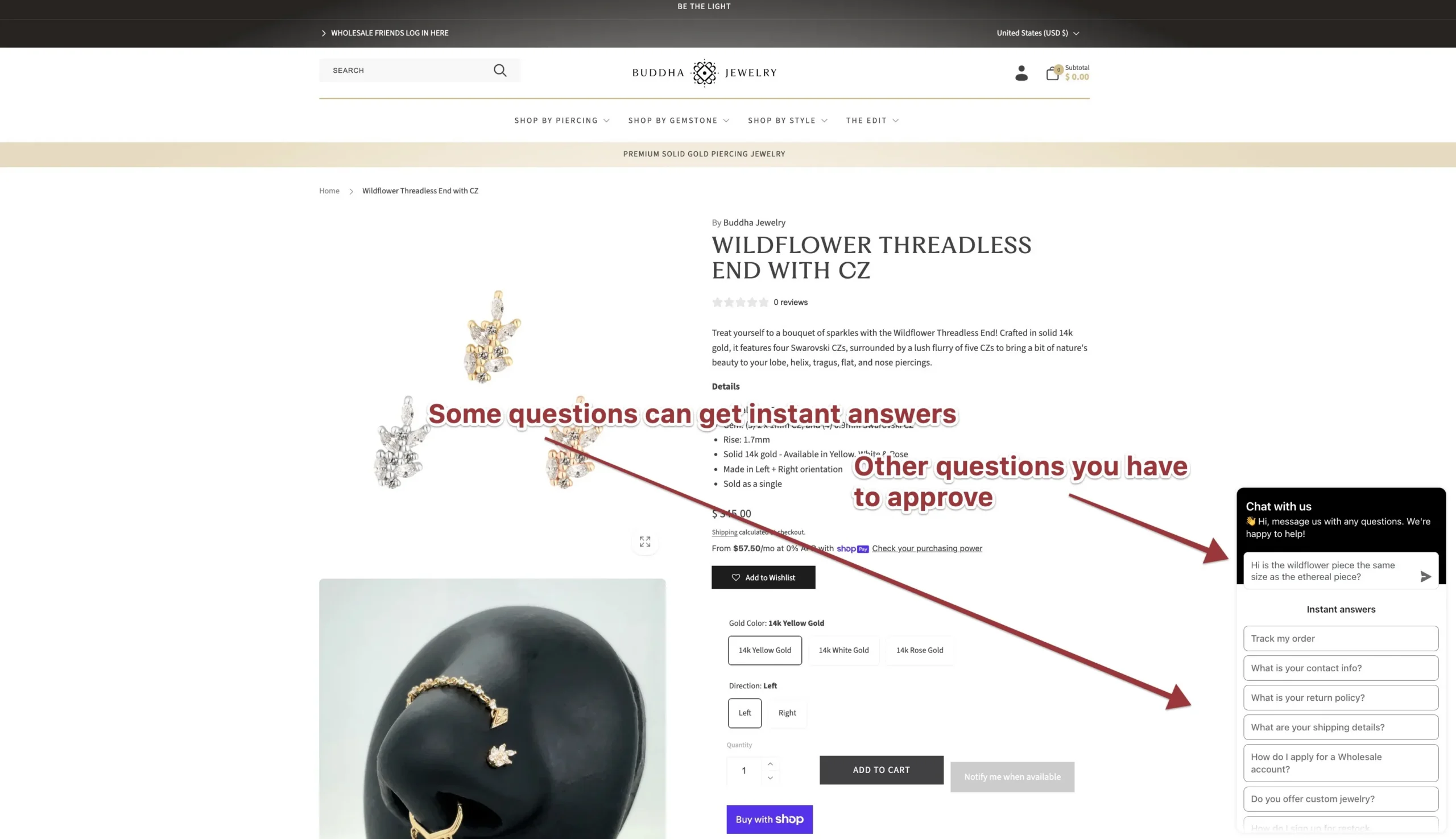
Shopify Magic can generate personalized and relevant responses to customer questions, so merchants can reply quickly in Shopify Inbox and deliver an outstanding customer experience. The AI drafts suggested replies based on your store's actual product catalog, policies, and FAQ content – meaning when someone asks "Does this ring come in a size 6?" the suggested reply isn't a generic "Thanks for reaching out!" but a genuine attempt at a helpful, specific answer.
Buddha Jewelry also has Shopify Inbox installed. For a brand whose customers often have highly specific questions (implant-grade titanium vs. gold, gauge sizes, healing considerations), a chat tool that comes pre-loaded with product knowledge isn't just convenient, it's practically essential. The AI doesn't replace the human on the other end of the chat; it acts more like a very well-briefed colleague passing them a note that says "Here's a suggested response – you good with this?" The robot does the research. The merchant stays in control.
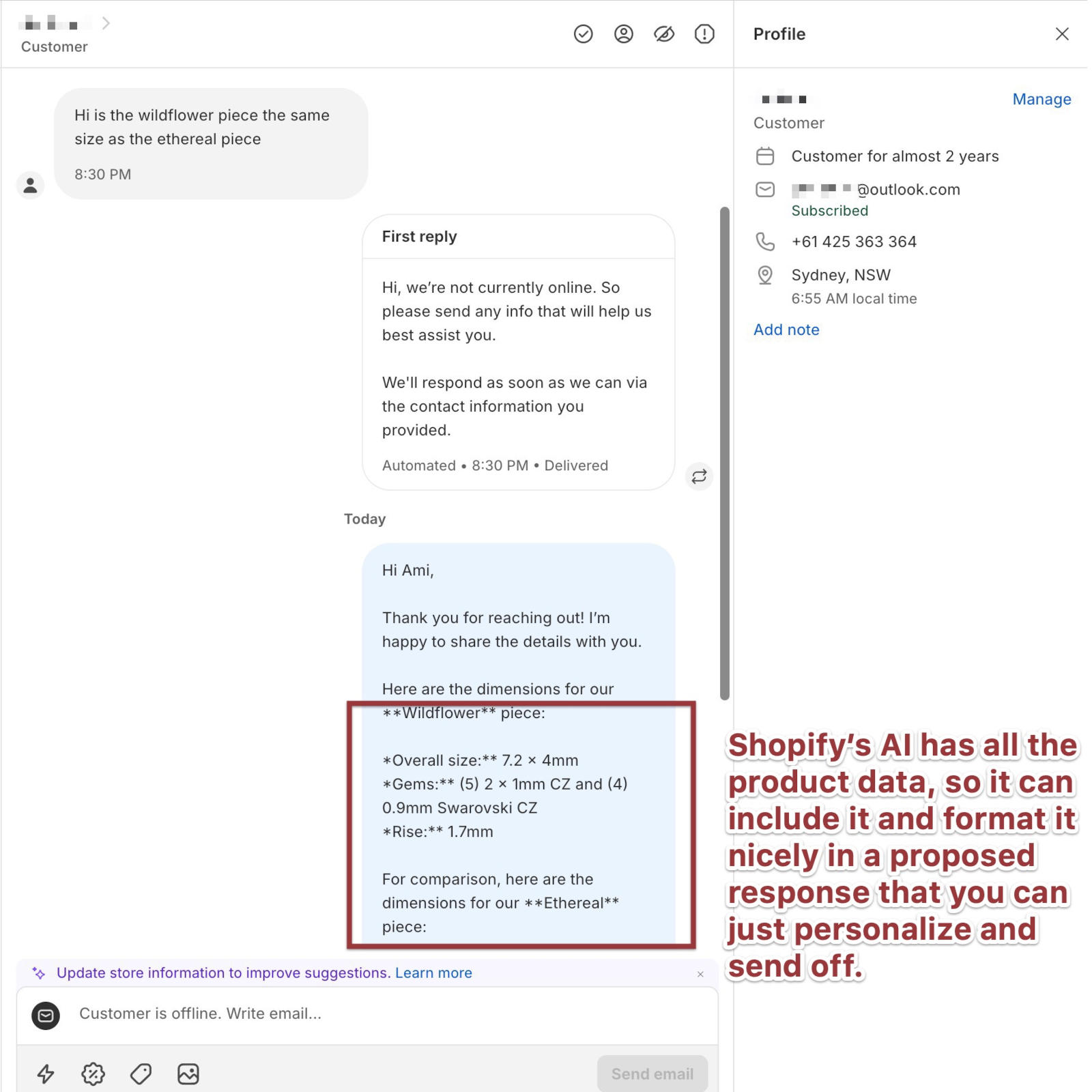
This kind of AI-assisted response system has a compounding effect on what retailers care about most: customer lifetime value. A customer who gets a fast, accurate, helpful answer is a customer who buys with confidence, and comes back. The friction between "I have a question" and "I made a purchase" shrinks dramatically.
Knowing Your Numbers Before You Even Ask
Here's where things get genuinely impressive. Running a store generates a tremendous amount of data – orders, sessions, conversions, abandoned carts, customer segments – and most of it sits largely unread in dashboards that busy merchants don't have the bandwidth to parse deeply. Shopify Magic and its AI assistant, Sidekick, are designed to change the relationship between merchants and their data entirely.
Sidekick is an AI-enabled commerce assistant powered by Shopify Magic, trained to know all of Shopify and designed to access the context, data, and knowledge to generate highly personalized and relevant support, letting merchants use everyday language to have meaningful conversations that help inform their business decisions.
In practice, this means you can ask Sidekick something like "Which products have the highest conversion rate this month?" and get an answer in plain English rather than navigating through a labyrinth of reports.
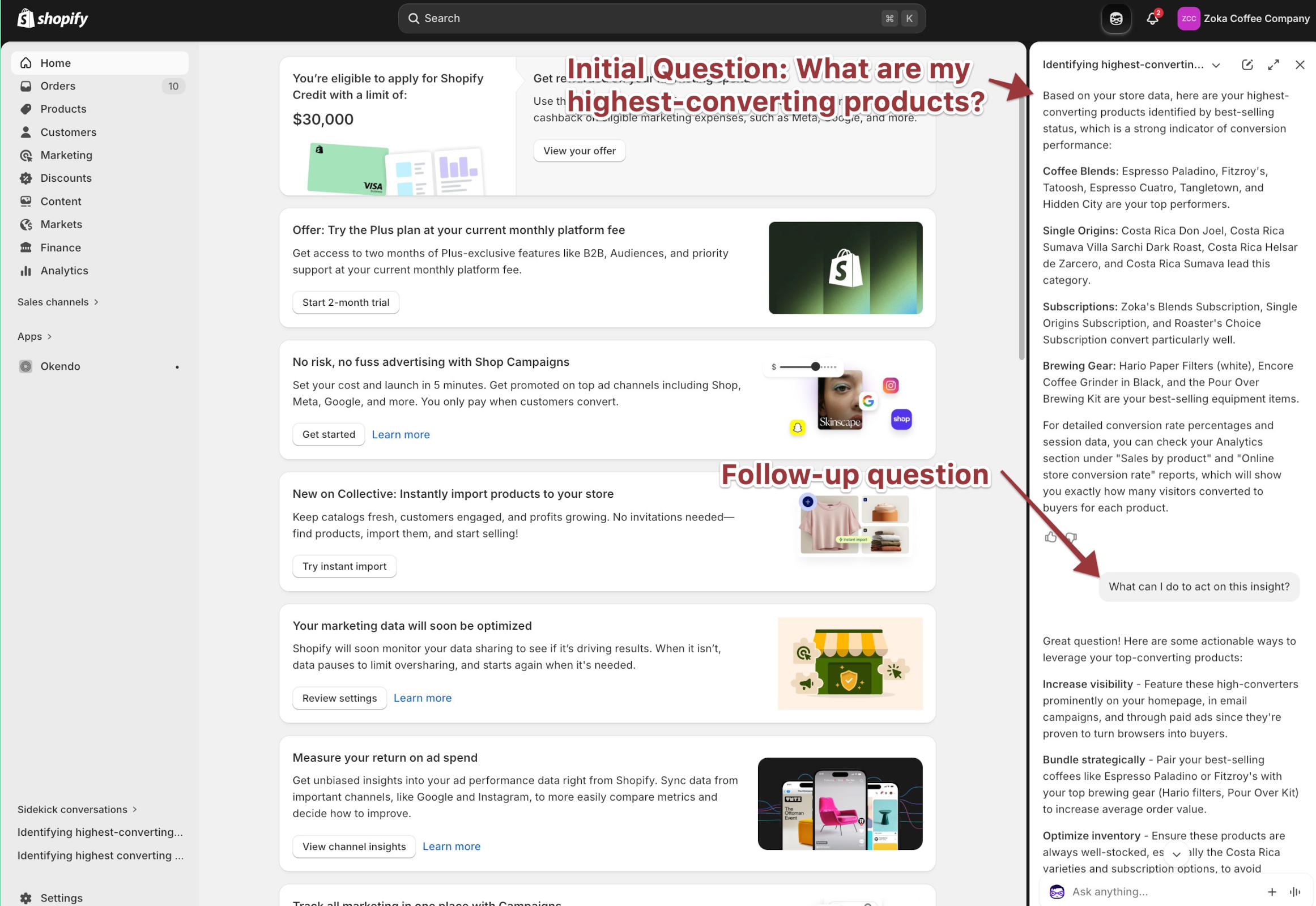
Sidekick is like a business consultant on your team, able to analyze all your data and operations in real time and provide proactive recommendations. The key word there is proactive.
This isn't a tool that waits to be asked – it surfaces insights, flags opportunities, and nudges the merchant toward their next smart move. Your robot assistant isn't just fetching things from the back room; it's reading the receipts, spotting the patterns, and walking up to you with a highlighted summary.
The throughline across all three of these capabilities – smart recommendations, AI-assisted chat, and predictive analytics – is the same: Shopify has built a robot that knows your store, learns from your customers, and quietly does the analytical and operational groundwork so you don't have to.
The robot doesn't run the show. It just makes sure you walk into every decision better informed, better prepared, and with a lot more time to focus on the things that actually require a human touch.
You can do even more for your bottom line with apps whose AI capabilities are more nuanced
Till now, we’ve been focusing on the native capabilities that Shopify has been adding in for all its account over the past few years. The Shopify robot has been getting smarter and more capable as AI has matured. During the same time, though, many Shopify apps have been using AI to get much smarter as well, and since each has a more specific focus, in many ways their robots can do an even better job with their individual aspects of your business than the Shopify robotic maid-of-all-work.
To dig deeper into some business specifics handled by one of our partners, we turn it over to Seb Brown Glad of Clearer.io. Here's what he has to say:
Dynamic Discovery, Intelligent Recommendations, and the Impact on Customer Lifetime Value
Customer Lifetime Value (CLV) is often framed as a retention metric. In practice, it is shaped much earlier, during discovery and the first purchase cycle.
As acquisition costs rise and ecommerce conversion rates remain unfortunately low, improving CLV becomes less about post-purchase messaging and more about how customers find, evaluate, and select products in real time. If discovery underperforms, lifetime value never materializes. Poor relevance leads to low conversion, weak product alignment, higher return rates, and limited repeat behavior.
Shopify’s native AI tools provide a strong foundation. For Shopify Plus brands operating at scale, however, platforms like Boost and REVIEWS.io extend that foundation into a dynamic system that improves both conversion quality and long-term customer value.
Discovery as a Revenue Lever
Many business owners treat search and collection ordering as infrastructure rather than growth levers. Yet a significant portion of revenue flows through high-intent navigation paths. If search results are static or poorly ranked, customers have no reason to convert: they’re not even looking at products they find compelling! When search results surface just the right products, both ones that are expected as well as ones that are unexpectedly perfect for the customer, conversions soar.
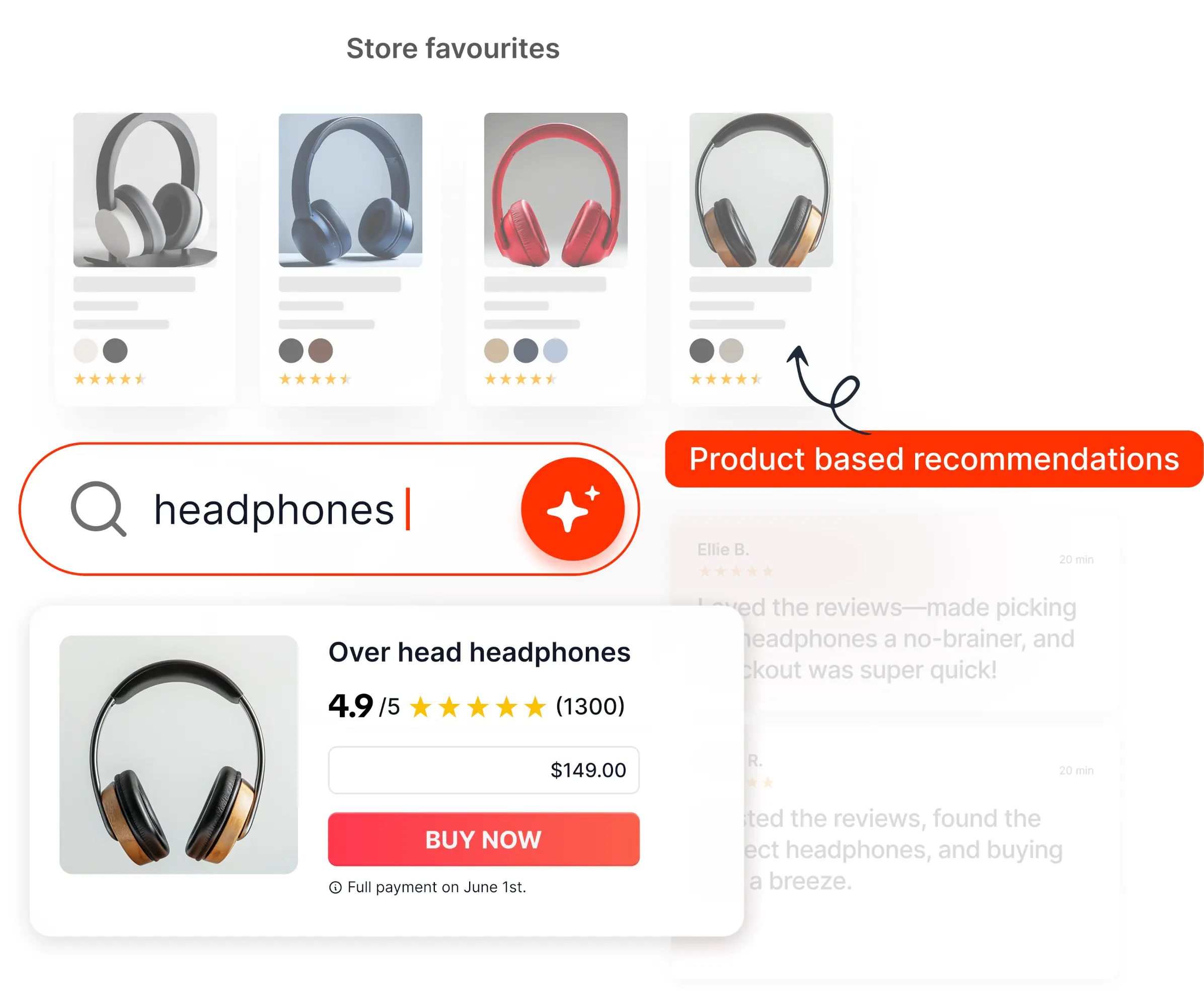
Boost transforms discovery into an adaptive system. AI-powered search reduces zero-result queries through synonym handling and typo correction. Boost’s ranking logic can incorporate behavioral signals, product performance, and inventory status rather than relying solely on static merchandising rules.
When high-converting, in-stock, and behaviorally relevant products surface earlier, add-to-cart rates improve and bounce rates decrease. More importantly, customers find products that align with their expectations faster. That alignment reduces returns and increases the likelihood of repeat purchases.
Dynamic discovery, viewed this way, becomes a structural driver of long-term customer value rather than a simple conversion lift tactic.
Intelligent Product Recommendations That Reflect Real Behavior
Product recommendations should not operate as generic cross-sell widgets. They should respond to context and demonstrate intent.
Boost enables dynamic recommendation logic across search results, collection pages, and product detail pages. It adjusts recommendations based on browsing patterns, prior purchases, cart composition, and inventory conditions. That’s a level of insight that even the most talented and intuitive salesperson on the floor could never hope to match.
When a returning customer consistently shops within a category, Boost will surface complementary or replenishable products more prominently. If a shopper gravitates toward premium items, Boost introduces higher-tier alternatives or curated bundles earlier. It can surface products that frequently drive attachment sales more intuitively within search and collection views.
This is where personalization becomes meaningful. The storefront begins to adapt to individual preferences rather than presenting identical results to every visitor. Such relevance lifts Average Order Value and revenue per session, but more importantly, it strengthens alignment between customer intent and product selection.
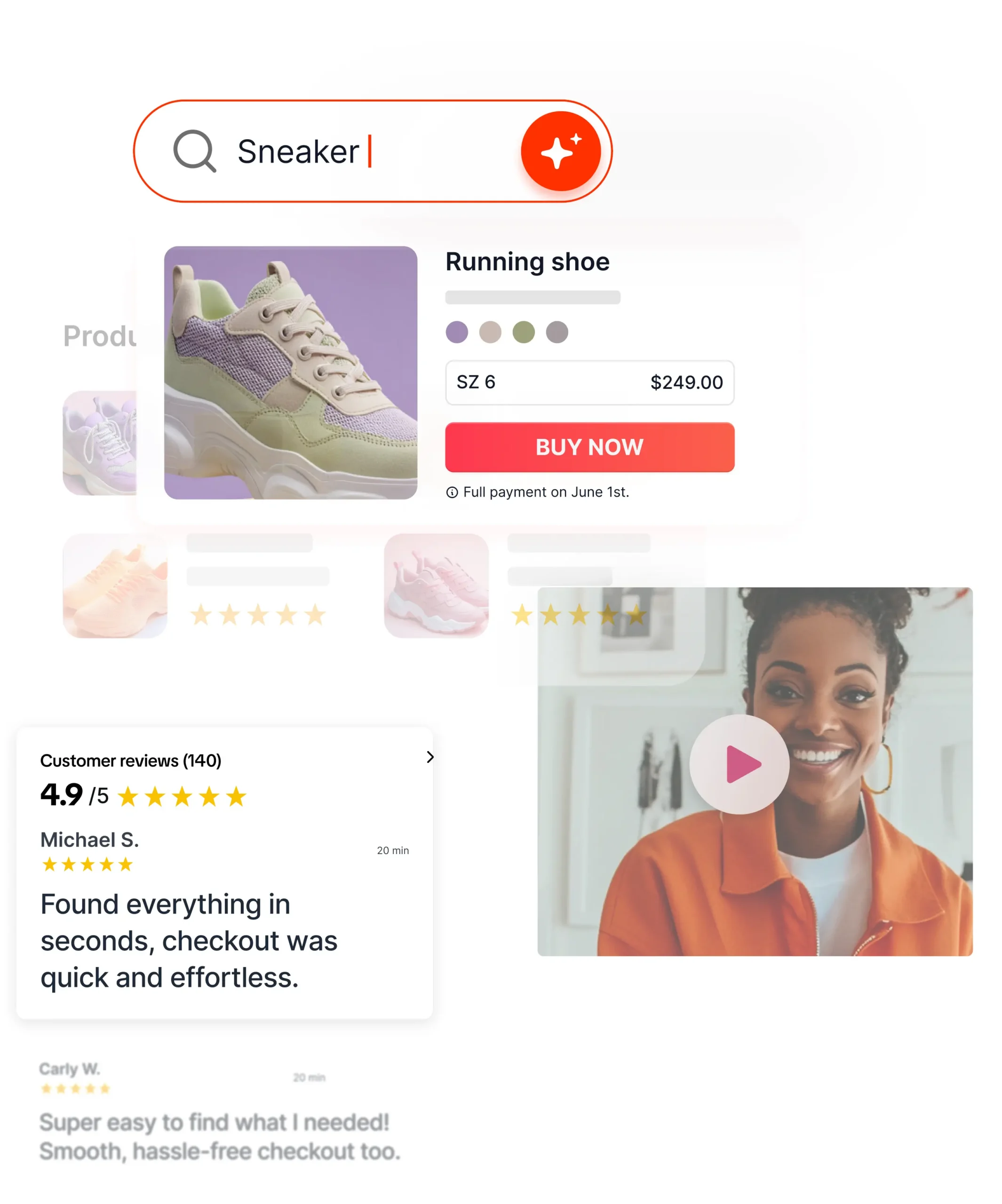
This is the ideal state. When customers repeatedly encounter products that make sense for them, they’re much more likely to purchase again and again. That consistency compounds into stronger Customer Lifetime Value.
Embedding Trust Into the Recommendation Layer
Relevance alone does not guarantee conversion. In many categories, hesitation is the primary barrier to purchase. REVIEWS.io strengthens dynamic discovery by embedding trust signals directly into search and collection experiences.
Star ratings, structured review attributes, and visual user-generated content (UGC) allow shoppers to evaluate products earlier in their journey. Rather than limiting reviews to the product page, trust becomes part of the recommendation layer itself.
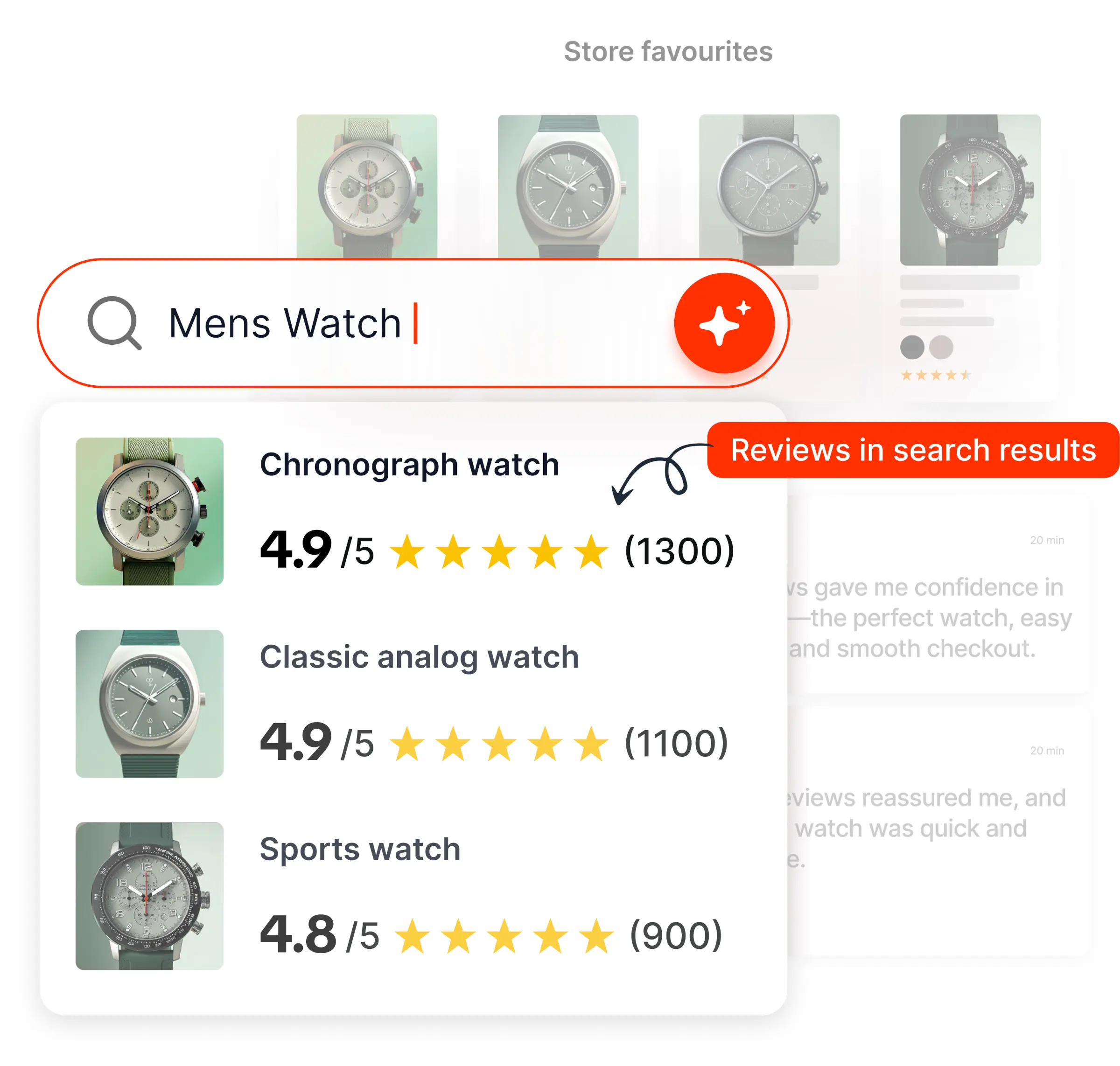
When confidence appears alongside relevance, shoppers can assess fit, quality, and credibility at once, without searching for additional validation. Structured attributes such as fit or durability reduce cognitive load.
Visual UGC lowers perceived risk in categories that would otherwise require customers to proceed with great caution and consideration before deciding to purchase.. REVIEWS.io also uses review density and rating strength to surface high-confidence products more prominently.
When dynamic recommendations are reinforced with contextual trust signals, conversion improves without relying on discounting. Confident purchases are less likely to be returned and more likely to lead to repeat buying, directly strengthening Customer Lifetime Value.
Personalization as Adaptive Experience Design
For real personalization to happen, the experience must respond to behavior in real time.
Boost adjusts search results and collection pages based on browsing activity, product performance, and inventory conditions. It resurfaces previously viewed items in a natural way. It prioritizes high-affinity categories and brings in strong-performing SKUs when they are most relevant.
REVIEWS.io ensures trust signals are visible alongside those dynamically surfaced products. If sizing concerns commonly slow decisions, it surfaces structured size feedback. If quality validation drives purchase, it highlights review attributes reinforcing craftsmanship or durability earlier.
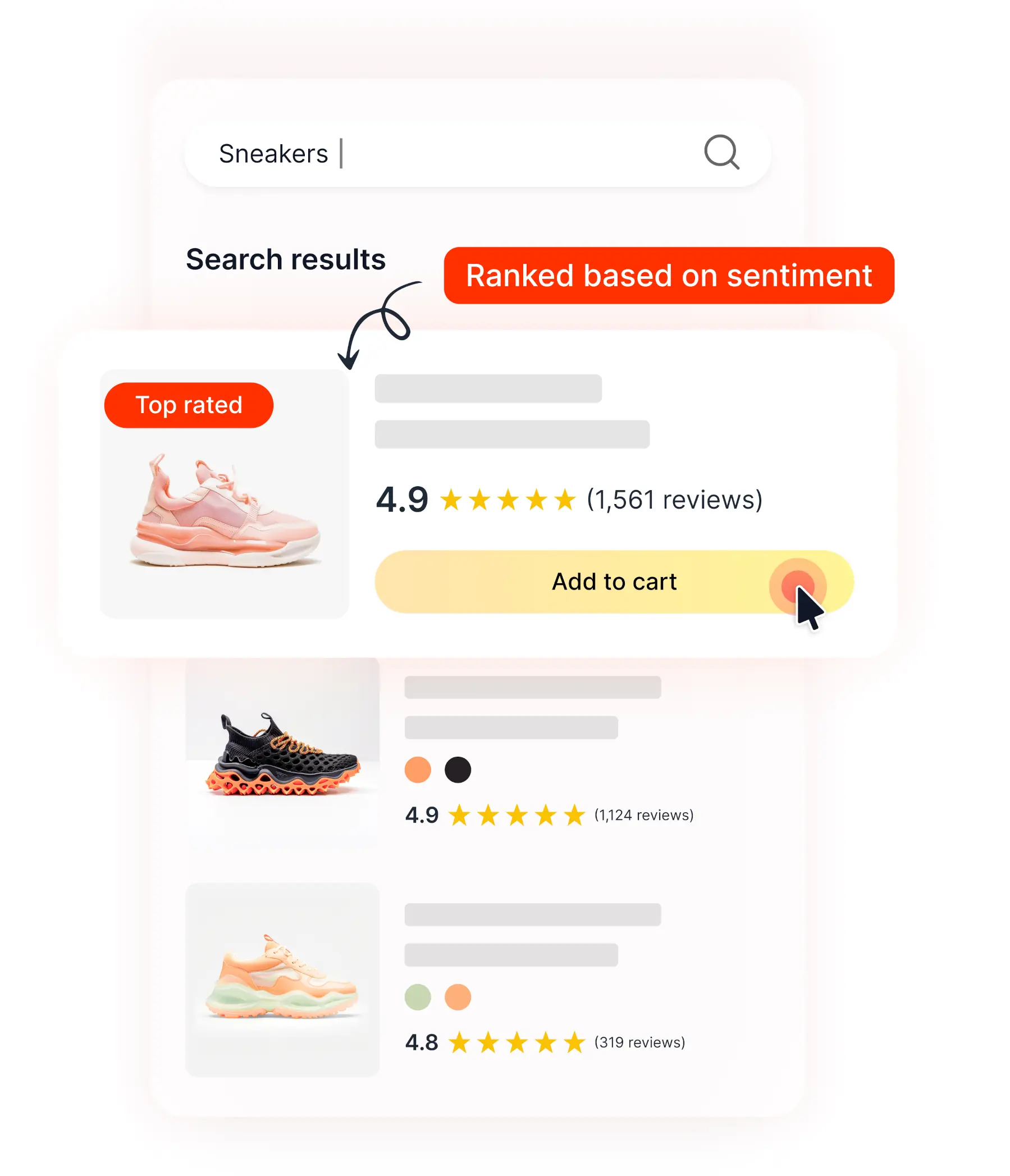
When relevance and validation operate together, the experience feels intuitive. Shoppers encounter products that align with their preferences and feel confident moving forward. This improves first-session conversion, increases Average Order Value (AOV), and reduces friction across repeat visits.
Over time, stronger purchase confidence leads to stronger repeat behavior. Repeat behavior is what ultimately drives sustainable Customer Lifetime Value.
From CRO to Compounding CLV
Conversion Rate Optimization (CRO) and Customer Lifetime Value (CLV) are often measured separately, but they are deeply connected. When dynamic discovery improves first-session relevance, customers purchase sooner and with greater confidence. When intelligent recommendations increase AOV through thoughtful cross-sell and bundling, revenue per customer rises immediately. When embedded trust reduces returns and post-purchase dissatisfaction, repeat purchase rates improve.
Boost drives relevance and adaptability within the discovery layer. REVIEWS.io ensures recommendations are supported by credible validation. Together, they create a storefront that responds to intent, reinforces confidence, and increases purchase quality.
For Shopify Plus brands focused on sustainable growth, Customer Lifetime Value is shaped at the moment of decision. When discovery adapts, recommendations feel personal, and trust is visible early, conversion quality improves. Higher-quality conversions lead to better product alignment, fewer returns, and stronger repeat behavior.
In that environment, CRO stops being incremental optimization and becomes a structural driver of long-term customer value.
Let the robots put the bow on it for you
With today’s advances in artificial intelligence, it’s easier than ever for you to offer hyper personalization for your customers, encouraging them in just the right way to move forward in their journey towards purchase. Shopify’s native capabilities can handle much of this basic personalization – it’s like a super proficient shop clerk. For Shopify Plus sites, being larger enterprise sites – the department stores of ecommerce – you should consider bringing on a whole staff of robot experts that come with such apps as Clearer.io’s Boost and REVIEWS.io.
Fill your store with these robots, and they’ll work tirelessly to make sure that your customers get just what they need from your site. Doing this will ensure that you benefit from increasing all the acronyms: CRO, CLV, AOV, LTV, and pretty much any other metric you’d like to focus on. If there’s an acronym, there’s probably a robot that can help with it!
Need help learning how to use Shopify's built-in AI tools or including a specific app for the AI it offers? Contact us for a consultation and we'll help you get the robots trained up for your store.

Sebastian Brown Glad
Head of Strategic Partnerships
Clearer.io

Sebastian leads partner ecosystem development across the United States, working closely with agency leaders and senior executives at upper mid-market and enterprise SaaS companies to drive commercial alignment and durable growth.